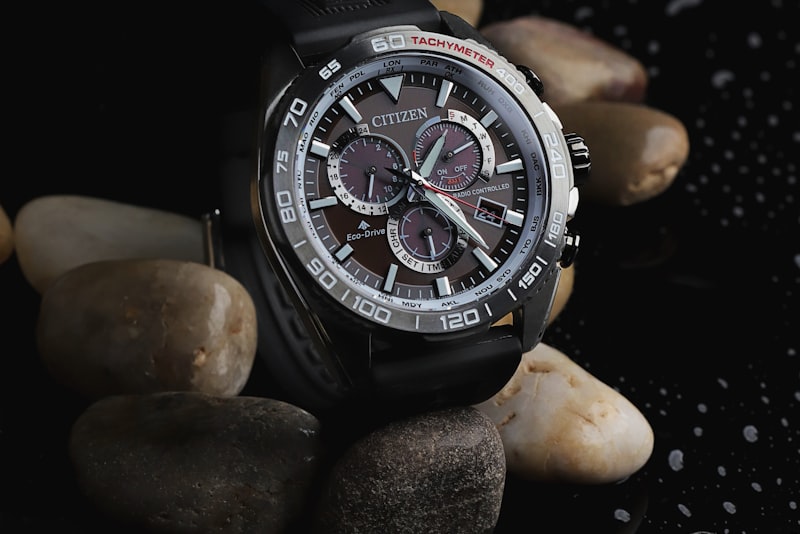
A mechanical watch is one of the few everyday objects that runs entirely on stored physical energy, with no electronics and no battery. Wind it, and a tiny tightly coiled spring slowly releases its tension to drive hundreds of moving parts in careful coordination. Understanding how that chain of components works makes a mechanical watch far more rewarding to own, and it helps you treat it with the care it deserves.
The Power Source: The Mainspring#
Everything starts with the mainspring, a long, thin strip of hardened steel alloy coiled inside a circular housing called the barrel. When you turn the crown on a hand-wound watch, you tighten this spring. As it slowly unwinds, it releases the energy that powers the entire watch.
The amount of energy stored determines the power reserve, which is the length of time a watch runs after being fully wound. Common figures range from around 38 to 42 hours on many traditional movements, while some modern designs reach 70 hours or more by using a longer or more efficient mainspring. Once the reserve runs out, the watch simply stops until you wind it again.
A key point for beginners: the mainspring does not release energy evenly. It pushes harder when fully wound and weaker as it unwinds. The rest of the movement exists, in large part, to smooth that uneven force into a steady, reliable beat.
The Gear Train: Passing Energy Along#
From the barrel, energy flows through a series of meshed wheels and pinions known as the gear train (or wheel train). These gears do two jobs at once:
- Transmit power from the slowly turning barrel toward the regulating parts.
- Divide time so that the seconds, minutes, and hours hands each rotate at the correct speed.
The gear ratios are calculated so that one wheel completes a rotation every minute, another every hour, and so on. The hands you see on the dial are simply attached to specific points in this train. It is a beautifully mechanical way of counting, with no software involved.
The Heart of Timekeeping: Escapement and Balance Wheel#
If the gear train ran freely, the mainspring would dump all its energy in seconds and the hands would spin uselessly. The job of controlling that release falls to two of the most important parts in any mechanical watch.
The Escapement#
The escapement acts as a gatekeeper. In the most common Swiss lever design, a small anchor-shaped lever locks and unlocks the gear train in tiny, rapid steps. Each time it releases, it lets the train advance by a precise increment, then locks again. That ticking sound you hear is the escapement doing its work many times per second.
The Balance Wheel and Hairspring#
The escapement is governed by the balance wheel, a weighted wheel that swings back and forth, paired with a fine coiled hairspring. Together they behave like a pendulum, oscillating at a fixed rate. Each swing allows the escapement to release one step of the gear train.
This oscillation rate is measured in vibrations per hour (vph) or beats. Typical figures include:
- 18,000 vph (a slower, vintage-style beat, often visible as a slightly stuttering second hand)
- 21,600 vph (a common modern rate)
- 28,800 vph (very common today, giving a smooth-looking sweep)
- 36,000 vph (high-beat movements designed for added stability)
The faster and more stable the oscillation, the more precise the watch tends to be, though higher beat rates can demand more careful lubrication and servicing.
Automatic Winding: Energy From Your Wrist#
Many mechanical watches are automatic (also called self-winding). They add a weighted semicircular rotor that swings as your wrist moves. That motion winds the mainspring throughout the day, so an automatic watch worn regularly may never need manual winding.
If an automatic sits unused for longer than its power reserve, it stops and simply needs a few turns of the crown or a bit of wrist movement to restart. Many automatics can also be wound by hand as a backup. A manual (hand-wound) watch lacks the rotor, so winding it daily becomes part of the routine that many enthusiasts genuinely enjoy.
Accuracy, Materials, and Why It Drifts#
A mechanical watch will never match the precision of a quartz watch, and that is expected. Accuracy is usually quoted in seconds per day, with figures of roughly minus 4 to plus 6 seconds per day considered very good for a chronometer-grade movement. A healthy everyday mechanical might run within ten to twenty seconds per day.
Several real-world factors nudge the rate:
- Temperature, which subtly changes the elasticity of the hairspring.
- Position, since gravity affects the balance differently when the watch lies flat versus standing on its side.
- Magnetism, which can disturb the hairspring; some movements use antimagnetic materials such as silicon to resist this.
- Wear and old lubricant, which is exactly why servicing matters.
Quality movements use jeweled bearings, typically synthetic ruby, at high-friction points to reduce wear. You will often see a watch described by its jewel count, such as "21 jewels," referring to these tiny bearings rather than anything decorative.
Caring for a Mechanical Watch#
Because a mechanical movement is a precise mechanical system, it benefits from periodic maintenance. Lubricants gradually dry out and friction increases over the years, so most manufacturers recommend a full service every several years, with the exact interval and procedure specified in your watch's documentation. Always follow that manufacturer guidance rather than a generic rule of thumb.
A few sensible habits help:
- Wind gently and stop as soon as you feel firm resistance on a hand-wound watch.
- Keep it away from strong magnets such as speakers, tablet covers, and some bag clasps.
- Respect the water-resistance rating and follow the maker's guidance on water exposure and on having gaskets checked.
- Avoid hard knocks, since sharp impacts can disturb the delicate balance and hairspring.
It is worth saying plainly that buying a mechanical watch should be about enjoyment and craftsmanship, not a financial plan. Some pieces hold value well, but a watch is not a guaranteed investment, and you should never buy one expecting it to make you money.
Conclusion#
A mechanical watch is a closed loop of clever physics: the mainspring stores energy, the gear train passes it along, and the escapement and balance wheel meter it out in steady, countable beats. Once you can picture that flow, the ticking on your wrist stops being a mystery and becomes a small, living machine you can appreciate and care for properly.